|
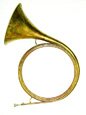
The modern orchestral horn, or French Horn, represents a deveopment from hunting horns which were first used as musical instruments during the 16th century. The familiar configuration of a large flared bell developed about 1650 in France and is a large version of the smaller crescent-shaped horns that had been redesigned with circularly coiled tubing. The French hunting horn, or the Cor de Chasse, entered the orchestra in the early 1700s, produced about 12 tones of the natural harmonic series with the most useful range for melodic writing in the upper harmonics (the "clarino" range) where the natural harmonics are close together.
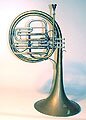
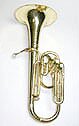
In the 18th century Hornists found that by hand-stopping - which involves inserting a hand in the bell of the horn - they could alter the pitch of the natural notes by as much as a whole tone. However, cumbersome lengths of tubing, called crooks, were still necessary for playing in different keys. The invention of valves in the early 19th century revolutionized the horn, allowing the player to alter the length of the tubing by the motion of fingers. The modern F horn employs a funnel-shaped mouthpiece leading to 3 valves and circular coils of narrow tubing and flaring to a wide bell. The hornist can produce a chromatic scale over 3 octaves, running upward from the B below the bass clef.
Click here to hear a modern horn solo
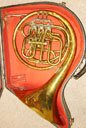
The double horn, introduced about 1900, is equipped with a fourth valve to switch to separate Bb tubing, which offers certain technical and intonation advantages. Most modern symphony orchestras include four horns. please click here for a detailed discussion on French Horn history -
|